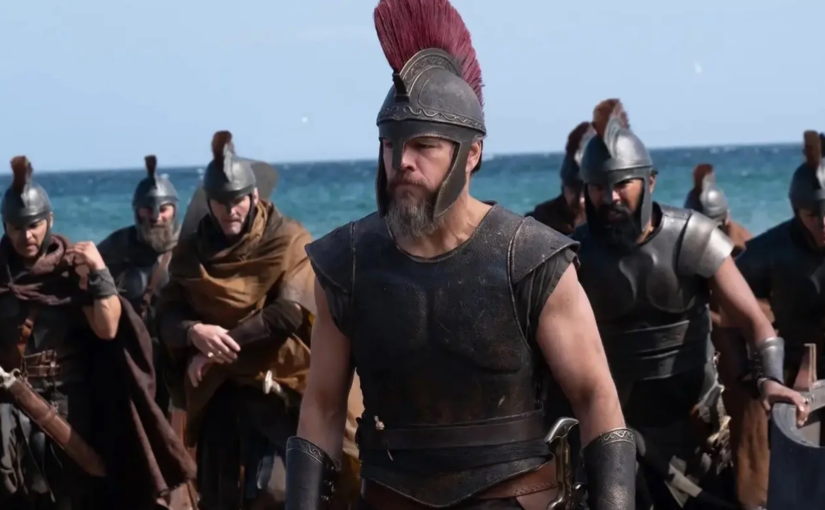
The Daily Wire is an extreme right-wing media company founded by Jeremy Boreing and the way more infamous Ben Shapiro. At the peak of streaming wars after the 2020 pandemic subsided, they launched Daily Wire+. This new streaming service was intended to go against “woke Hollywood” – yada yada yada – around the time Disney’s live action Snow White remake was still in production. They exploited the controversy surrounding Disney and announced their own competing Snow White film staring Brett Cooper, a political commentator and actress. Obviously, both would wound up in development hell but only one able to deliver.
As for Brett, she would eventually leave the Wire to join Fox News but not without staring in Pendragon Cycle. You see, the Daily Wire+ is mostly vision of one man, Jeremy Boreing. He has made a lot offensive anti-trans films that don’t deserve a mention. The Pendragon Cycle is a show that adopted the first two books of the same name that were written by Stephen Lawhead.
Lawhead wanted to write a story based on Arthurian mythology but with a Christian spin. There was a brief period in time when said mythos blended Christian traditions until society got tired of singing the same ol’ tune and moved on. Lawhead wanted to bring that back. So the books weren’t created to own the libs. It was just one person’s genuine vision to write something they liked.
Being one of the few least offensive thing on the Wire’s streaming service, it’s safe to say that Pendragon Cycle that this was their attempt at going mainstream again after Snow White film got cancelled. If you’re wondering where Brett fits in, well…
The Show
Before I begin, a lot of my information comes second hand from Jose’s nearly hour long review of the show. Is this the best to comment on a piece of media? Probably not. But it’s either that or give the world’s most transphobic streaming service my money and I’m not doing that. So pick your poison.
Brett plays Ganieda, Merlin’s love interest. Merlin is the show’s main protagonist. Problem is he isn’t exactly a lovable teddy bear compared to his parents. Most of the time he is just dark and brooding. Which would be fine if his character arcs supported it. Much of it revolves around the concept of faith. Problem is the narrative never really challenges this or calls it into question.
In fact it’s, Charis, Merlin’s mother and a refugee from Atlantis is the one who did not worship Yahweh and paid the price for it. So if anyone would be question of their faith, it would be her. But instead she mostly just stands around hoping someone eventually takes Excalibur. And that basically sums up Ganieda as well. Only she gets killed and that motivates Merlin to do the thing that the plot gets rolling again. We’re only told about Ganieda’s greatness after she’s written out of the show. Which makes the entire episode named after pointless.
In typical Daily Wire fashion, the reason for this was because Boreing wanted to have woman remain stereotypical stay at home moms. But that doesn’t really work for a fantasy epic? Or ever. Like, the show literary opens with Charis wrestling a bull just before Atlantis fell. So it’s not like women in the world of Pendragon aren’t capable. Also Ganieda was pregnant at the time of her death. So she didn’t even have time to be a mother. So the one thing that would motivate her to stay at time wasn’t really there, ether.
One Season, Two Books
So the reason why it’s called the Pendragon Cycle the books follows a nation coming to it’s own. Most of Season 1 is basically laying the groundwork for King Author. As I alluded to earlier, this first season follows Merlin and is literary titled “The Rise of Merlin”. Unfortunately, cramming two books into a single season is naturally going to kill the pacing.
We spend the first two episodes alone getting to know Merlin’s parents. It begins with, Taliesin, his father who has a Moses-style story to build a better world through Britain. In the second episode, he is shot dead just as wife goes into labour. We later fast forward to an adult Merlin stuck in the wilderness. We learn about him through flashbacks of his childhood before the rest is spent on a globetrotting adventure to build up an army to defend Britain until Ganieda’s death. It’s only when he remembers his much more colourful and lighthearted father that he returns to society. If the show weren’t already derailed off a cliff, now it’s bursting into flames Back to the Future-style.
You see, Merlin inherited his father’s gifts and although he has a lot of on his plate, it’s his question of faith that’s supposedly the crux of the issue. But Christianity and all of traditions are pretty much the norm here. If anyone deserves that character arc it’s Charis. She should be an emotional mess after watching her society crumble at the hands Yahweh but we don’t get that. Instead, she converts to Christianity and hooks up with Taliesin almost instantly. Then spends the rest of the season asking someone, anyone, to take Excalibur following his death. So if anyone is going to be having a question of faith, it’d be Charis. Not Merlin.
And the narrative somewhat acknowledges this contradiction. The other story thread dwells on Merlin struggling to come to grip with his powers. It isn’t until Ganieda’s death that he snaps and kills everyone responsible without any mercy. This ties in with the faith question in that he does submit Yahweh after he returns to society. But it still doesn’t make sense within what we’re given. If the bullfighting Atlantians can flip on a dime, what exactly is he worried about? He has their genes.
Who Is This For?
Like I said, Pendragon Cycle is the least offense thing on the Wire’s streaming service. It isn’t that bad. Just a confusing mess. Obviously, the books are going to outweigh the series by a long shot given Boreing’s direction. But if the goal was to mainstream, they pretty much failed. Mainstream requires catering to everyone. And not everyone is a bigoted transphobe who thinks women should stay at home even in a fucking fantasy.