During the 2020 pandemic, I got into D&D for the first time. My new friends and I used tabletop simulator and D&D Beyond to successfully play the game. Now I’m using it to flesh out my characters by adopting some elements from D&D. For example, my main fursona, Max, plays a guitar and is more or less the equivalent to a Bard. I also aim to adopt some of the game mechanics to add some level of internal consistency within my stories.
This all leads me to finishing up an EPUB version of version 5.2 D&D’s System Reference Document (SRD). An SRD serves as reference for a role-playing game’s mechanics and is usually under some license that allows third-party creators to make compatible material for the game. In the case D&D, the current SRD derives from the 2024 Edition of the Player’s Handbook, often known as 5.5E. The only real change between mine and official PDF copies is that I renamed Wizards to Mages. That aside, it all functions the same and is a more of cosmetic difference.
The 2024 edition is my favourite simply because they ditched the concept of Races in favour of Species, which is more accurate. I shouldn’t need to explain why the former term was more problematic. But it really showed its limitations when it came to including other animal-inspired creatures, such as the Tabaxi. Another new feature that I like is emphases on creating a background leading up to the events of the game. That’s useful even outside of D&D. Like, I could easily retool it into a guide to write a character to build an actual story for. I actually follow artist who created fun fictional world based around D&D. It has plenty fun and comedic that make it a joy to watch, especially during these dark times.
There a quite a few things that still need taken care of. Formatting and bringing back missing tables. This is mostly the result with how it transcribed from PDF to text. That process was done by someone who converted it to a hybrid Markdown format. The tables were in HTML and didn’t render when I exported to EPUB. There are also a few aesthetic changes I made to the file that work in Markdown but not in HTML. Thankfully, these are just lists. Not that big a deal but does require delaying it in favour of a simple preview. The cover image is something in the public domain. It isn’t the best but it’s better than nothing.
In the Hands of the Commons
But if you want to how I can do this without a legal sniper hunting me down, then that deserves giving a bit of a background.
In the past, the SRD used the Open Game License (OGL). The OGL was open in so much that you don’t step on their trademarks. They would only let you use the phrase “Dungeons & Dragons” as it relates to being compatible with so-and-so edition. Similar to how software can only use “macOS” or “Windows” to say that they are for that platform but can’t pretend their Apple or Microsoft. Fair trade, all things considered. The OGL was more or less a commercial license created a time when physical copies were more frequently distributed.
Fast forward to 2023 and Wizards of the Coast (WotC) tried to slip in a clause into the OGL that would have granted the company get a larger cut of the royalties from third-parties who sold their additions to the game on their new online platform, D&D Beyond. Naturally, this upset everyone when it was discovered and the company quickly found themselves in hot water. After discussing it with their lawyers, they decided to release it under the Creative Commons Attribution (CC-BY) license alongside the OGL.
As the name suggests, the CC-BY gives you permission to do whatever the hell you want as long you give credit to the original author. Going forward all new versions of SRD would exclusively be under the CC-BY and so far they’ve made good on that end of the deal with 5.2. This is how I’m able to share the SRD without WotC sending the legal hounds at me.
What Is D&D Now?
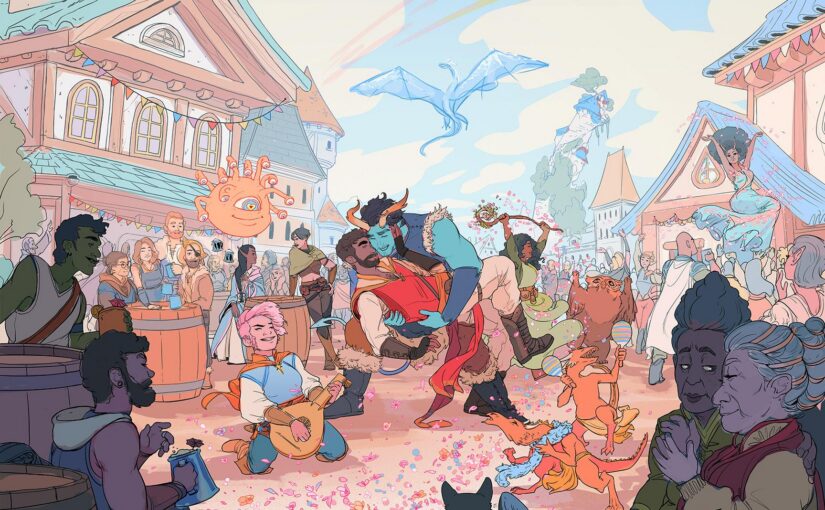
A very small – yet loud – group of people protested WotC for having the audacity promoting the colourful and optimistic picture that I featured above. Because it’s not like what they shared isn’t 99% of all D&D campaigns. Heaven forbid we have a little joy in the world.
But with D&D placed under the Commons, it’s fair to say that we can do whatever the hell we want with it now. Like if you want your campaign to be dark and brooding as Batman, that’s fine but don’t ruin it everyone else.
All the SRD and Player Handbook are game rules meant to keep things on track. They don’t describe the lore or anything like that. At least not in any reasonable depth. Additional content or your imagination is meant to fill in that those gaps. With the SRD under the Commons, this is even truer now than it ever was before.